
Will AI Kill Desk Jobs Before Manual Work? The Quiet Indian Job Shift Explained
The Quiet Power Shift: Why Manual Jobs Could Outlive Desk Jobs
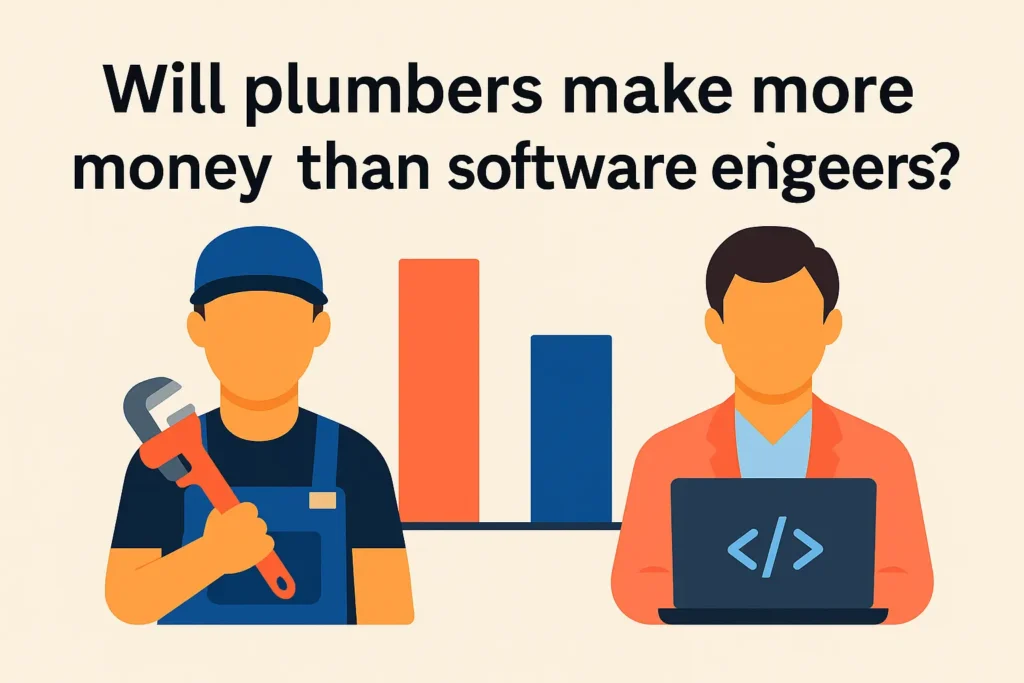
Will plumbers make more money than software engineers?
The question sounds dramatic, almost like clickbait, but it captures the confusion and tension in India’s job market right now. For years, we assumed that AI would first threaten farmers, factory workers, drivers, and anyone doing physical work. But that prediction isn’t lining up with reality. The real disruption is happening inside India’s air-conditioned offices, not its fields.
Across the country, many companies are quietly trimming digital and desk-based roles because generative AI can now perform predictable, screen-heavy tasks at scale. The Economic Times recently reported that more than 50,000 white-collar jobs are under pressure as AI automates customer support, basic coding, data entry, and documentation work. Source economic times
AI Is Reshaping India’s Job Market Faster Than Expected
Even major IT giants aren’t immune. Reuters confirmed that TCS cut 12,000+ jobs — around 2% of its entire workforce — as part of an “AI-enabled restructuring.”
Source: reuters
Ed-tech companies reduced their content teams. BPO companies froze entry-level hiring. Customer-experience firms replaced chat agents with AI platforms. These are all digital-first jobs, and ironically, they are the easiest for AI to learn and automate.
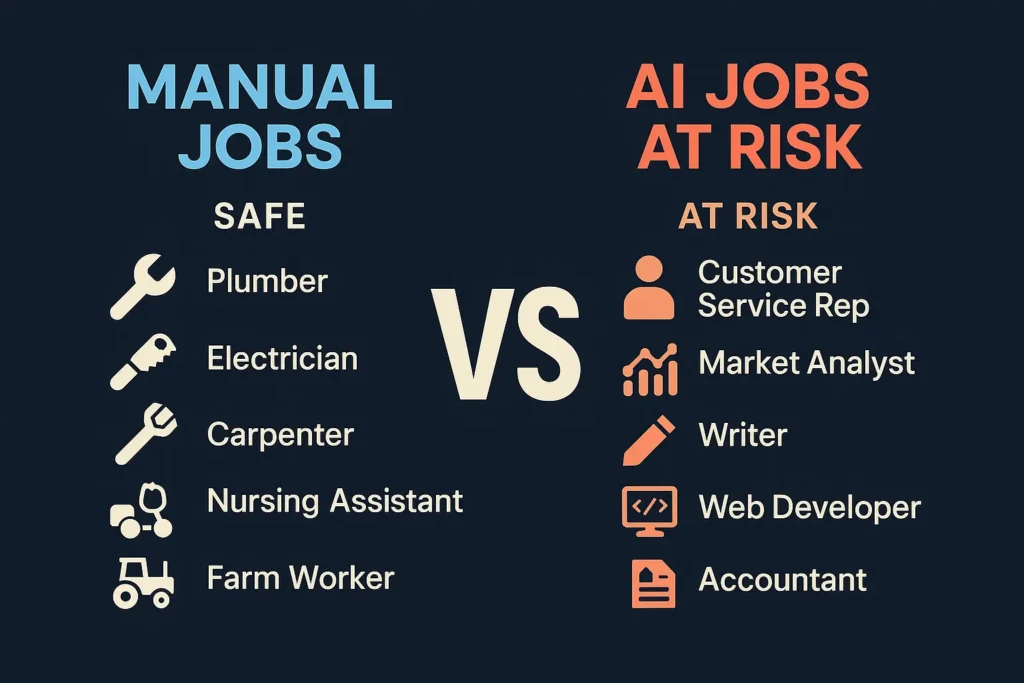
But here’s the twist: while the pressure on desk jobs rises, the roles we used to think were “low skill” or “replaceable” — plumbers, electricians, drivers, nurses, carpenters, farmers, mechanics — are emerging as some of the most secure and future-proof jobs in the workforce.
Microsoft Research offers a clear explanation. After studying 200,000+ real user interactions, the conclusion was simple: AI’s strengths lie in writing, summarizing, analyzing, and processing information — tasks done behind screens.
Source: Microsoft
Why Manual Jobs Are Becoming More Future-Proof?
Think of a plumber repairing a pipe in Cuttack, a nurse assisting a patient in Bhubaneswar, or a mechanic diagnosing a strange engine sound in Sambalpur. These jobs require physical coordination, presence, judgment, and human connection — things AI cannot replicate, no matter how advanced the model becomes.
The Brookings Institution backed this with global data: 60–75% of tasks in finance, business, software, writing, and customer service are automatable through AI. Meanwhile, construction, agriculture, field-based work, and repair jobs have under 15% AI exposure.
Source: brookings
This is the quiet power shift unfolding in front of us.
For decades, Indian families pushed their children toward “laptop jobs” — seen as safer, higher-status, and more financially stable. But AI is flipping this mindset. The safest careers today aren’t sitting in front of a screen; they’re the ones that depend on skill, touch, mobility, and human judgement. A nurse is more future-proof than a junior analyst. A carpenter has more job stability than a digital content writer. A mechanic’s job is safer than a data-entry operator’s.
And this shift actually reveals something important: the work we undervalued for years wasn’t low skill. It was just invisible to those who never had to rely on it. The modern world can pause a marketing campaign, but it can’t function without technicians, helpers, healthcare workers, sanitation staff, or skilled tradespeople.
Here’s what the data shows:
Jobs most affected by AI (high AI exposure):
- Writers
- Translators
- Market analysts
- Customer support agents
- Technical writers
- Journalists
- Editors
- Accountants
- Ticketing agents
- Web developers
- Policy analysts
- Data entry operators
(These roles depend heavily on predictable digital tasks — AI’s comfort zone.)
Jobs least affected by AI (low AI exposure):
- Plumbers
- Electricians
- Carpenters
- Nursing assistants
- Phlebotomists
- Mechanics
- Roofers
- Machine operators
- Cleaners
- Farm workers
- Drivers
- Childcare workers
(These jobs require physical work, care, or field problem-solving — areas AI can’t replace.)
The World Bank’s South Asia report confirms this clearly: India’s rural and manual workforce shows very low AI exposure, while the highest-risk roles belong to urban, laptop-heavy jobs. So instead of asking “Will AI take away our jobs?”, the better question is:
Which jobs will AI disrupt, and which jobs will become more valuable because AI cannot touch them?
Because the shift isn’t just economic. It’s cultural.
AI is challenging the old prestige ladder. Jobs once considered backups may become premium. Careers that looked “safe” because they involved technology may turn out to be the most fragile. And the roles that rely on hands, intuition, movement, and empathy may become the backbone of a stable economy.
The future of work in India won’t depend on who knows the fanciest tool. It will depend on who can use technology and still do what AI cannot — caring, fixing, building, repairing, connecting, and thinking with real-world awareness.
In that future, manual work is not outdated. It’s irreplaceable.